

Commercial | Domestic

One Way Weep Vent

£11.28

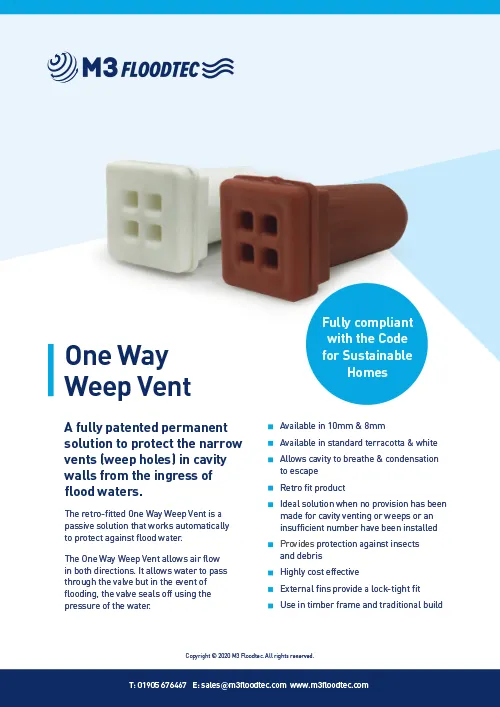
A fully patented permanent solution to protect the narrow vents (weep holes) in cavity walls from the ingress of flood waters.

SKU: M3WHVW Category:
Clear

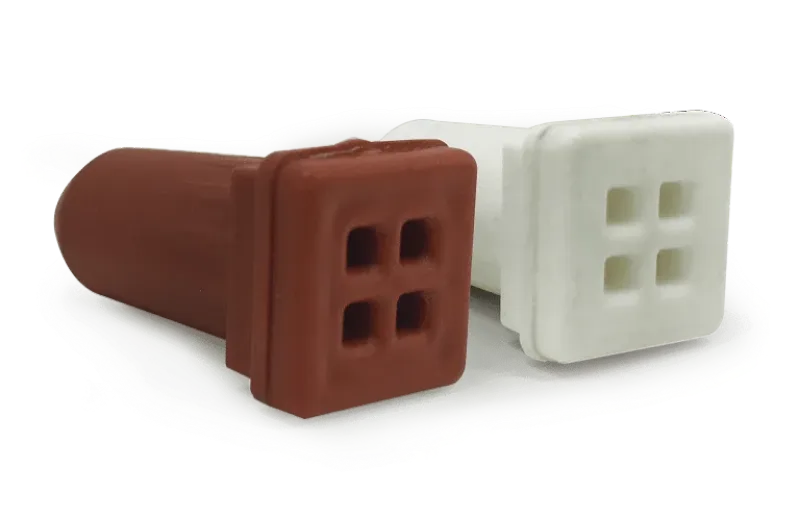
The retro-fitted One Way Weep Vent is a passive solution that works automatically to protect against flood water.

The One Way Weep Vent allows air flow in both directions. It allows air to pass through the valve but in the event of flooding, the valve seals off using the pressure of the water.

  • Available in 10mm
  • Available in standard terracotta & white
  • Allows cavity to breathe & condensation to escape
  • Retro fit product
  • Ideal solution when no provision has been made for cavity venting or weeps or an insufficient number have been installed
  • Provides protection against insects and debris
  • Highly cost effective
  • External fins provide a lock-tight fit
  • Use in timber frame and traditional build
Colour Terracotta, White
Construction

The One Way Weep Vent is manufactured out of high impact styrene, it consists of three parts.

Guarantee

2 year manufacturer’s guarantee.

UK Regulations, Standards & Guidelines
(NHBC Standards)
  • Retro-fitted cavity ventilator and weep hole duct for new build or refurbishment.
  • Size: 80mm L (excl. flange) x 26mm Dia. (inc. fins).
  • Free Area: 250mm² per unit.
  • 6.1 – D6 (b) Where fairfaced masonry is supported by lintels weep holes should be provided at 450mm (maximum) centres with at least two weep holes per opening.
  • Weep holes in rendered walls – NHBC Technical Newsletter April 2005 (Issue 32) If the outer leaf of a masonry wall is fully rendered then weep holes over cavity trays may be omitted. However, if the render stops short of the top of a wall and has a fair faced masonry panel above it then weep holes should be provided over the cavity trays within both the fair faced and the rendered section of the wall. The NHBC also recommend that any wall that supports ground should be drained to relieve water pressure.
The Building Regulations 2000, Approved Document C 2004 edition
  • Internal and external walls (moisture from the ground)
    – 5.5 (b) If the wall is an external wall, the damp-proof course should be at least 150mm above the level of the adjoining ground.
    – 5.5 (c) If the wall is an external cavity wall provide weep holes every 900mm to assist in the transfer of moisture through the external leaf. Where the damp-proof tray does not extend the full length of the exposed wall, i.e. above an opening, stop ends and at least two weep holes should be provided.

Retro Fit Cavity Wall

  • Installation into an existing cavity weep hole is fast and easy using an 10mm Weep Valve
  • Ensure to use a 10mm drill bit into the end of the existing cavity weep hole (ensuring the outlet does not become blocked and all bur is removed)
  • Ensure all mortar and any additional variant hole weep vent are filled and water tight
  • Apply a small amount of silicone around the shaft of the weep valve making sure that non is applied to either end blocking air holes
  • Place the Valve into the hole, this should be a tight fit to ensure a seal
  • Clean away any excess silicone and leave to dry

Aluminium Facade Weep

  • Installation into an existing Facade weep hole
  • Ensure to use an 10mm drill bit into existing weep hole
  • Apply a small amount of silicone around the shaft of the weep valve making sure that non is applied to either end blocking air holes
  • Place the Valve into the hole, this should be a tight fit to ensure a seal
  • Clean away any excess silicone and leave to dry

Related Case Studies

Two Castles Housing, Carlisle

Two Castles Housing, Carlisle

A key pre-requisite of this project was that the properties were protected with no visual impact

View Case Study