Automatic | Commercial | Domestic

Anti Flood Airbrick

(1 customer review)

£35.89

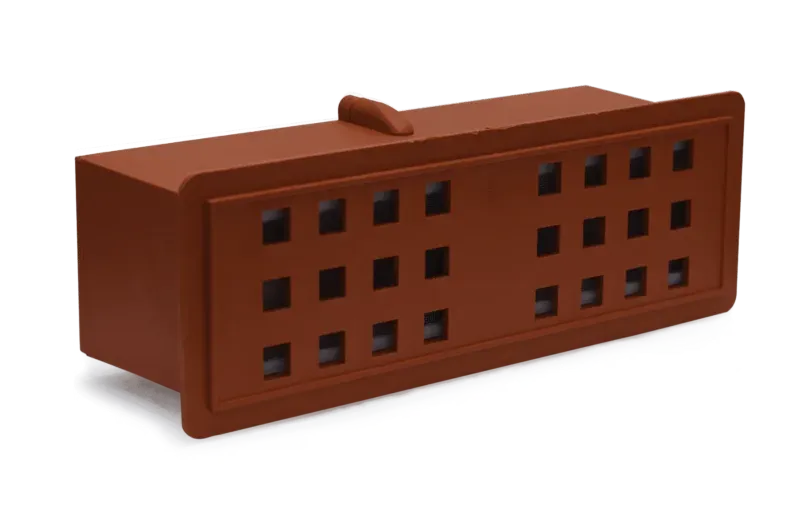
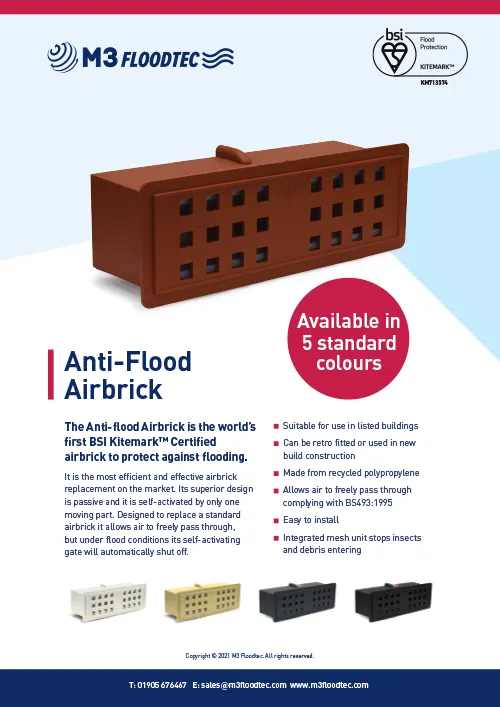
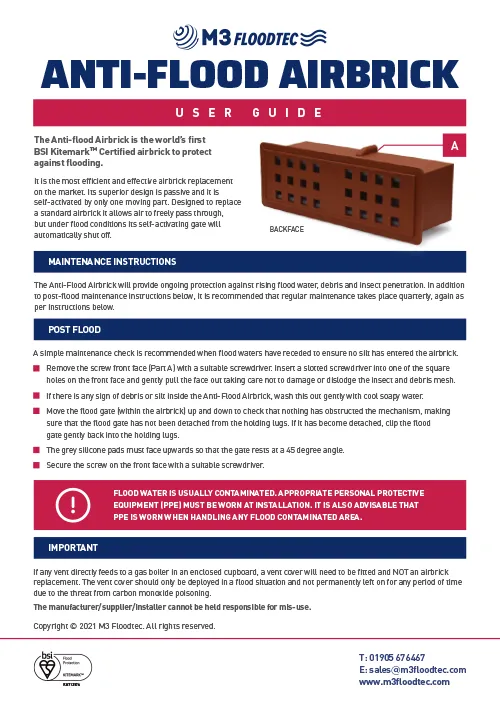
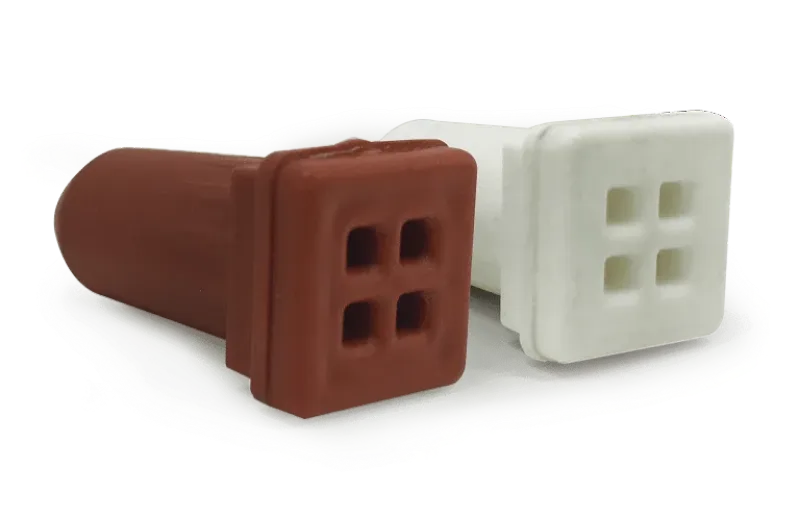
The Anti-flood Airbrick is the world’s first BSI Kitemark certified airbrick to protect against flooding.

SKU: M3AFA Category:
Clear

It is the most efficient and effective airbrick replacement on the market. Its superior design is passive and it is self-activated by only one moving part. Designed to replace a standard airbrick it allows air to freely pass through, but under flood conditions its self-activating gate will automatically shut off.

  • Suitable for use in listed buildings
  • Can be retro fitted or used in new build construction
  • Made from recycled polypropylene
  • Allows air to freely pass through complying with BS493:1995
  • Easy to install
  • Integrated mesh unit stops insects and debris entering


Colour Terracotta, Buff, Engineers Blue, Black, White
Applications
  • Can be fitted to single, double and triple airbrick apertures.
  • Can be installed in brick, concrete, stone, steel, render finished or hardwood structures
    across both domestic and commercial properties.
Certification
  • BSI Kitemark licensed product (KM713574). Passed the rigorous testing criteria of PAS
    1188-1:2014.
  • Complies with British Standard BS493:1995 to provide ventilation under floor voids and in
    wall cavities: provides 2400mm² of free airflow.
Construction

Main body, insect mesh and float constructed from recycled polypropylene co-polymer with UV
stabilisers.

Silicone sponge approved by the WRAS (Water Regulations Advisory Service).

Technical Information
  • Length: 210mm
  • Height: 62mm
  • Depth: 73.5mm

Excellent resistance to ozone, oxidation, ultraviolet light, corona discharge, cosmic radiation,
ionising temperature of -20° to 120°.

Minimum geometric open area of 2400mm² which meets the ventilation opening requirements of
1500mm² run of opposing walls/ 500mm per m of floor area for suspended ground floors/ 500mm per
m for wall cavities.

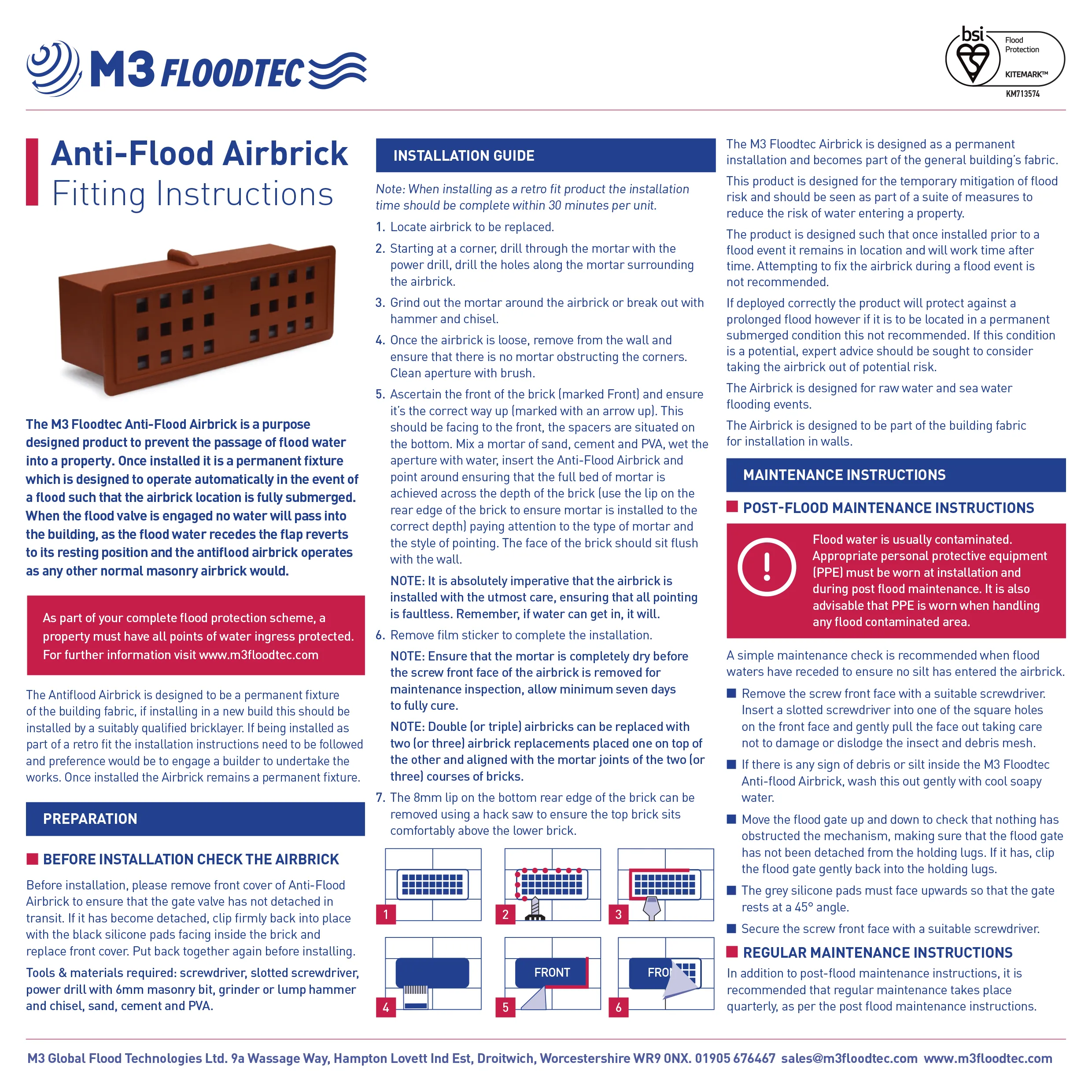
Note: When installing as a retro fit product the installation time should be complete within 30 minutes per unit.

  1. Locate airbrick to be replaced.
  2. Starting at a corner, drill through the mortar with the power drill, drill the holes along the mortarsurrounding the airbrick.
  3. Grind out the mortar around the airbrick or break out with hammer and chisel.
  4. Once the airbrick is loose, remove from the wall and ensure that there is no mortar obstructing the corners.Clean aperture with brush.
  5. As certain the front of the brick (marked Front) and ensure it’s the correct way up (marked with an arrow up).This should be facing to the front, the spacers are situated on the bottom. Mix a mortar of sand, cement andPVA,wet the aperture with water, insert the Anti-Flood Airbrick and point around ensuring that the full bed ofmortar is achieved across the depth of the brick (use the lip on the rear edge of the brick to ensure mortar isinstalled to the correct depth) paying attention to the type of mortar and the style of pointing. The face ofthe brick should sit flush with the wall.

    NOTE: It is absolutely imperative that the airbrick is installed with the utmost care, ensuring thatallpointing is faultless. Remember, if water can get in, it will.

  6. Remove film sticker to complete the installation.

    NOTE: Ensure that the mortar is completely dry before the screw front face of the airbrick is removedfor maintenance inspection, allow minimum seven days to fully cure.

    NOTE: Double (or triple) airbricks can be replaced with two (or three) airbrick replacements placed oneon top of the other and aligned with the mortar joints of the two (or three) courses of bricks.

  7. The 8mm lip on the bottom rear edge of the brick can be removed using a hack saw to ensure the top brick sitscomfortably above the lower brick.


Related Case Studies

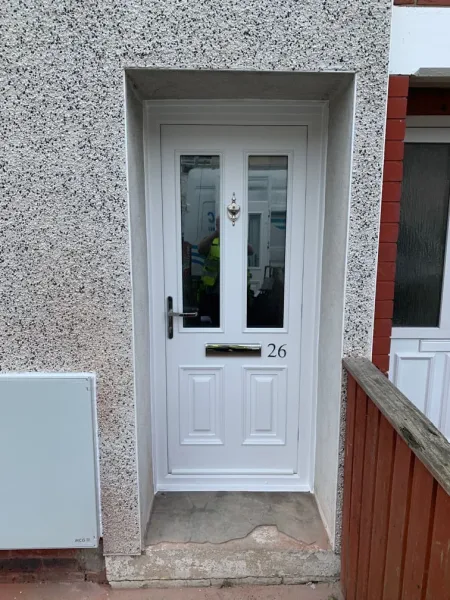
St Ledger Homes, Doncaster

St Ledger Homes, Doncaster

Large flood resilience grant funded project in Doncaster, manufactured and installed by M3 Floodtec

View Case Study
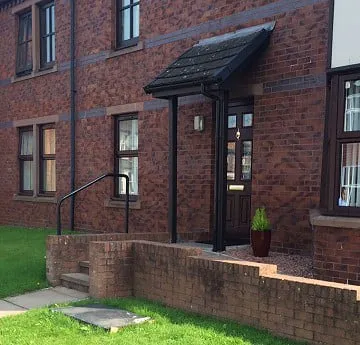
Two Castles Housing, Carlisle

Two Castles Housing, Carlisle

A key pre-requisite of this project was that the properties were protected with no visual impact

View Case Study
Tunbridge Wells Borough Council, Kent

Tunbridge Wells Borough Council, Kent

See how we helped protected 26 properties as part of a Defra funded Property Level Flood Protection Scheme

View Case Study
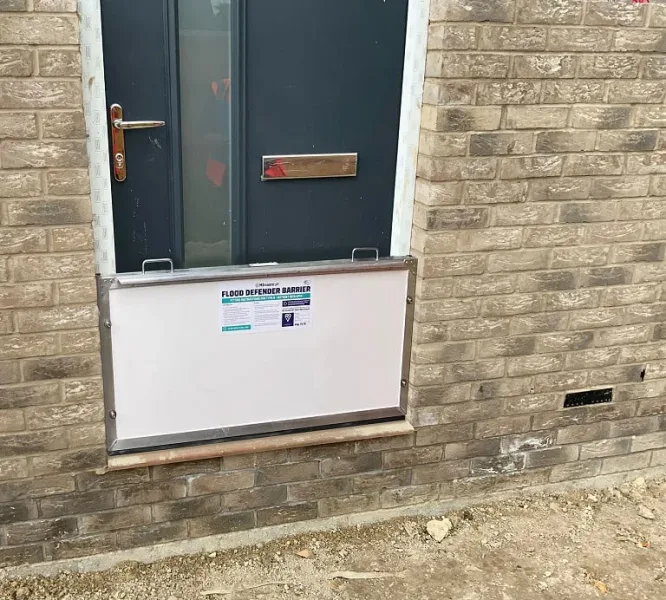
Legal & General, Modular Homes

Legal & General, Modular Homes

The incorporation of Anti-flood Airbricks to factory build modules followed by Defender flood barriers enabled developer L&G Modular to fulfil planning requirements

View Case Study
Tadcaster Medical Centre

Tadcaster Medical Centre

After the flood event in February 2022 the decision was made to implement Property Flood Protection

View Case Study
Greet Primary School, Birmingham

Greet Primary School, Birmingham

At M3 Flooodtec we have developed a Swing Hinge Defender Barrier System that can be used in conjunction with Emergency Escape routes

View Case Study